
Using it day to day
Last updated 15 July 2026
Part of the Starter Kit. There's nothing to set up on this page - this is just what living with it looks like.
Dump
Message your project anything, any time, from any device. A tidy list, a voice-note transcript of thought-spaghetti, one line from the school car park - all fine. Claude catches it, sorts it into its pages, and gives you a one-line "got it" so you can carry on with your day.
You never need to say where something should go. Tasks land in To do with the date. Worries that aren't tasks get held as context, not turned into jobs. Things about how you work get remembered.
Ask "where am I at?"
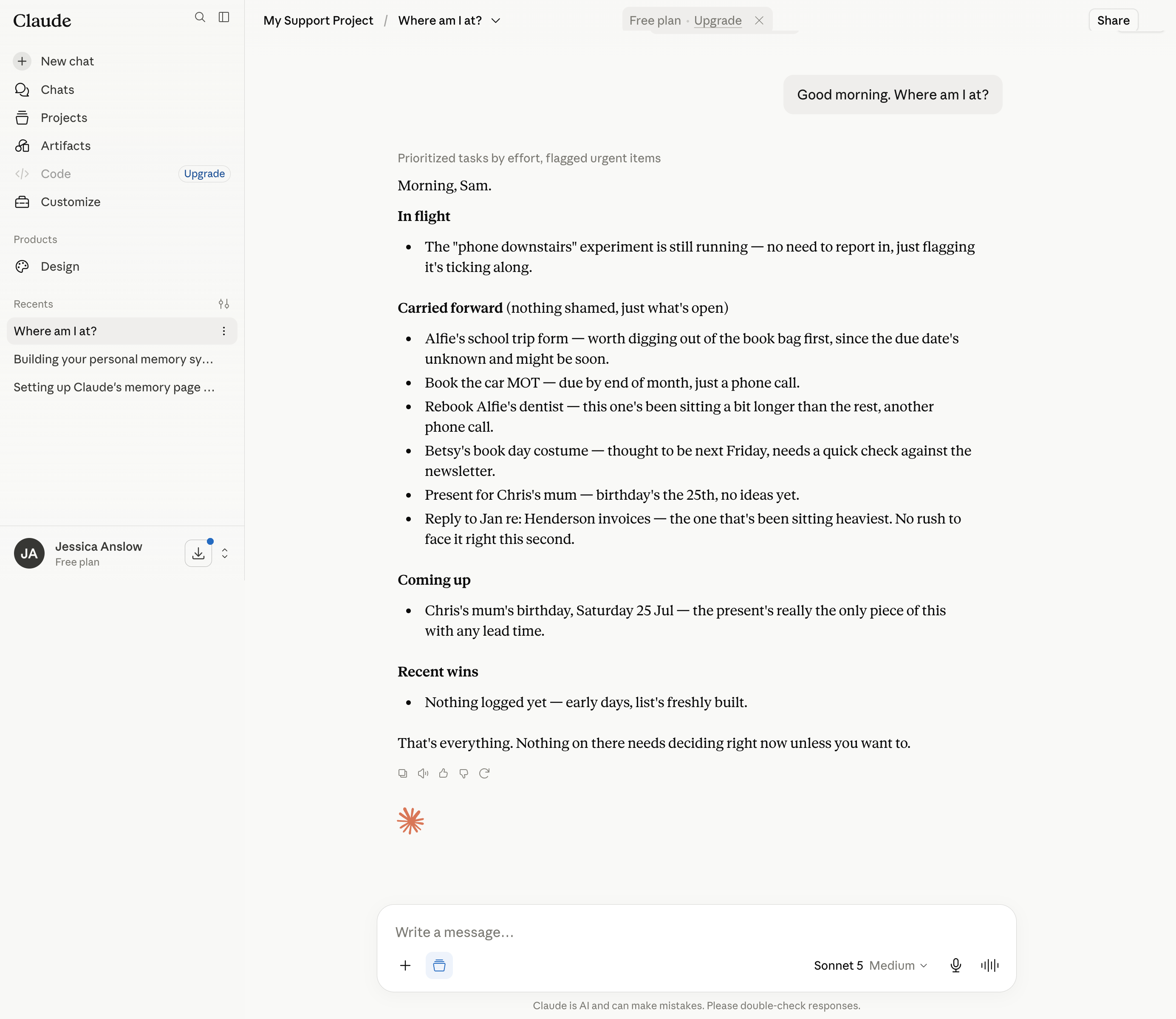
Whenever you want the picture - morning, 3pm slump, Sunday night - ask. In those words or any others. What comes back:
- In flight - what's actively moving
- Carried forward - what's still open, said plainly, with no shame attached
- Coming up - only what benefits from advance notice
- Recent wins - what you actually did, because effort counts
Easiest things first, always. The hardest thing is never at the top.
Check-ins (when a day needs one)
On heavier days, or whenever you ask for one, Claude offers a check-in. Not "how are you feeling?" - that question is famously unanswerable on exactly the days it matters. Instead, five small concrete questions, one at a time: how's your body (pain, heaviness, anything sitting somewhere)? How's the tank (empty, low, medium, okay)? How's your brain (clear, foggy, between)? How's the sensory side (world manageable, or a bit much)? And is anything sitting on you I should know about?
One-word answers are completely fine - the questions are built to be answerable even when words are hard. If five feels like a lot, body + tank + sitting-on-you is enough. Claude reflects back what it heard in a sentence, doesn't lecture, and shapes the day to match: rough answers mean fewer things, not the same list delivered more sympathetically.
Nothing rots silently
Every item you add opens a loop, and the loops age visibly instead of festering:
- A few days old: mentioned in passing, inside something else - never a nagging message of its own
- A week old: flagged plainly. "This is still open."
- Two weeks old: Claude brings it to you and you work it out together, starting with "anything blocking this?" Then it's do it, park it, or drop it.
Parked and dropped are decisions, not failures. A thing you've consciously parked with a resurface trigger is handled. That's the opposite of the guilt-pile at the bottom of every to-do app you've abandoned.
Read the pages, if you like
Everything Claude knows lives in your Notion, in plain view. Reading it is allowed and encouraged - it's your life. If something's wrong, say so in a conversation ("that's not quite right - Wednesdays are the hard ones") and it gets fixed and learned from.
You never have to maintain the pages. That's the point of the whole kit.
You never have to say goodbye
Sessions don't need closing. Wander off mid-sentence - the school run happens, the toddler happens, life happens - and nothing breaks. Claude keeps its pages updated as you talk, not at some formal ending you'd have to remember to perform. Next time you open the project, it picks up from its own notes.
And if you disappear for a month? Same answer, bigger gap. No streaks broken, no backlog guilt, no "welcome back!!" with three exclamation marks. Come back, ask "where am I at?", carry on. The system was built by someone whose weeks get eaten sometimes - it's designed for the return, not the streak.
When it gets something wrong
It will, especially early. Tone off, wrong priority, misread your energy. Say so, plainly - "that felt off" is enough. Corrections are the highest-value thing you can give it: they go into its page about how to work with you, and they stick. Early on you'll explain yourself a lot. Later, you won't have to. That shift is how you know it's working.